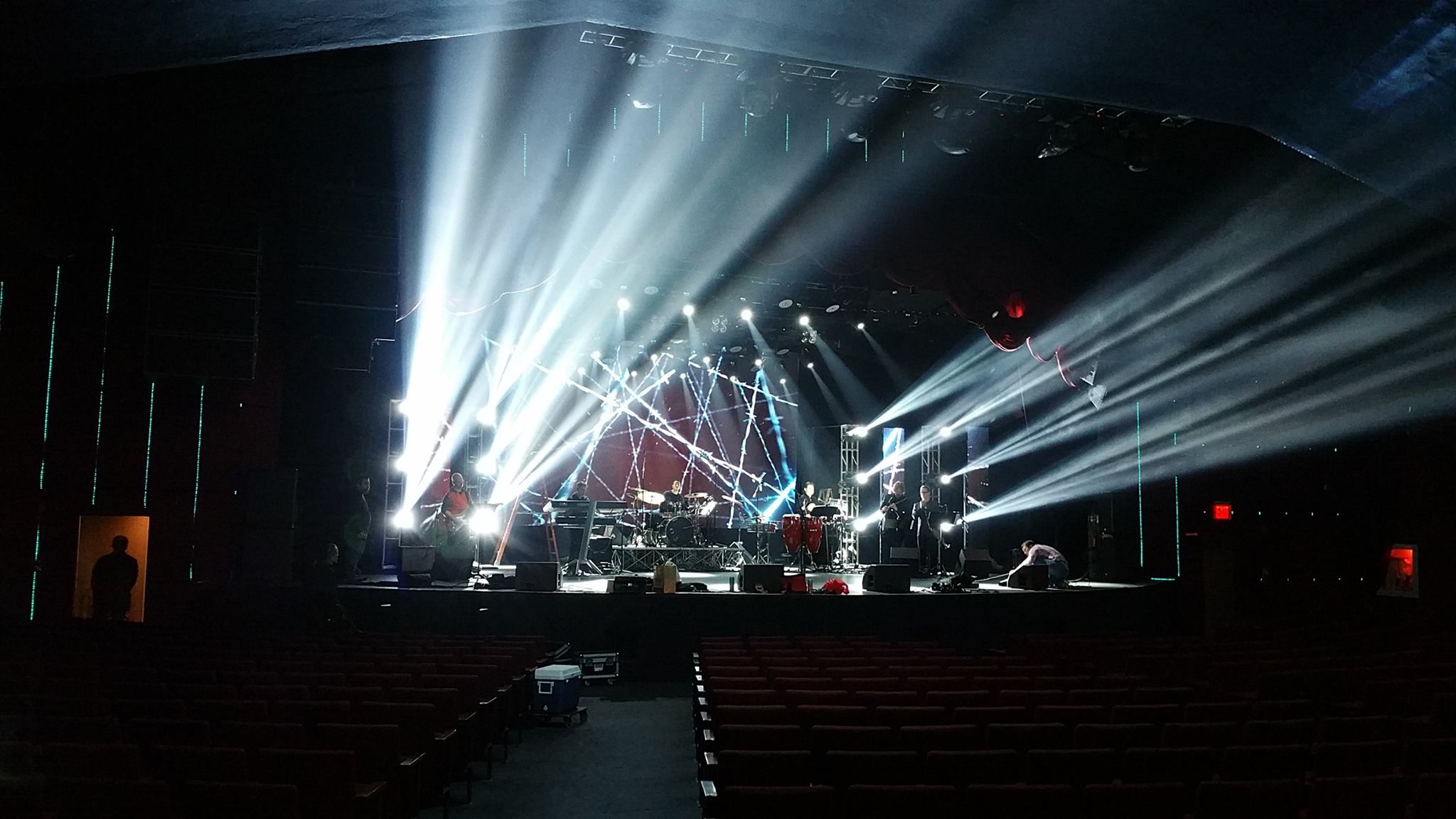
There exists an unspoken truth within the concert touring industry: automated moving head fixtures possess selective hearing. You can program them meticulously through grandMA3 software, test every cue during soundcheck, and watch them execute flawlessly—until the house lights dim and thousands of fans start screaming. That’s when the spotlights decide they have better ideas.
The Birth of Automated Rebellion
When Vari-Lite introduced the VL1 in 1981 for a Genesis tour, it revolutionized stage lighting forever. These automated luminaires could pan, tilt, and change colors without human operators physically touching each unit. Genesis fans witnessed something unprecedented lights that moved with the music, responding to electronic commands sent through early DMX control protocols. What the audience didn’t see were the moments when those pioneering fixtures chose their own destinations.
Four decades later, the technology has evolved dramatically. Units like the Martin MAC Ultra Performance and Robe ESPRITE pack computational power that exceeds the equipment used to land astronauts on the moon. Yet these sophisticated machines still occasionally look stage left when the cue clearly specifies stage right, as though they spotted something more interesting in the wings.
Protocol Pandemonium
The DMX512 protocol that governs most stage lighting communication sends instructions through chains of fixtures, each unit grabbing its designated channels from the data stream. In theory, this system operates with military precision. In practice, interference from radio microphones, poorly shielded cables near power distribution, or that one lighting bar that took a hard hit during load-in can corrupt the signal stream in ways that manifest as spontaneous fixture creativity.
Modern productions increasingly rely on Art-Net and sACN protocols that send lighting data over ethernet networks. These systems offer redundancy, higher bandwidth, and diagnostic capabilities that DMX512 cannot match. They also introduce network-related failure modes that would make IT departments weep. A single network switch with an undiagnosed firmware issue can turn a precisely programmed lighting rig into an interpretive dance piece.
The Followspot Operator’s Revenge
Despite all technological advancement, human-operated followspots remain irreplaceable for tracking performers across stages. The Robert Juliat Cyrano and Strong Super Trouper fixtures that illuminate Broadway leads and rock stars depend on skilled operators who anticipate movement and adjust in real-time. But even the most experienced spot operators cannot compensate when automated fixtures downstream decide to reinterpret the lighting design.
Consider the scenario: a followspot perfectly tracks the lead singer during the chorus, while fifty automated fixtures programmed to provide backing illumination suddenly execute a cue intended for the next song. The lighting board operator watches helplessly as carefully calibrated color temperatures clash, or worse, as beam positions create unintended shadows across the performer’s face the cardinal sin of concert lighting.
Temperature, Timing, and Temperament
Moving head fixtures contain motors, electronics, and optical components that generate substantial heat during operation. The Clay Paky Sharpy Plus and similar high-output units can push internal temperatures to levels that affect motor precision. A fixture running at thermal limits might lag slightly on its pan movement, arriving at its programmed position a fraction of a second late—enough to miss the drummer’s cymbal crash or the guitarist’s solo pose.
Touring fixtures face additional stress from constant transportation. The Ayrton Perseo Profile might leave Los Angeles in perfect calibration and arrive in Chicago with a motor that has developed opinions about its home position. Technicians call this fixture drift the gradual shift in mechanical accuracy that transforms precise programming into approximations. A lighting rig that executed perfectly yesterday requires recalibration today because physics and vibration have renegotiated the fixtures’ understanding of their positions.
The Programming Paradox
Creating a touring-grade lightshow involves weeks of programming using platforms like ETC Eos, MA Lighting grandMA, or Avolites Titan. Designers build elaborate cue sequences that respond to music timecode, creating shows that reproduce identically night after night. The programming becomes a masterwork of precision timing and spatial coordination.
Then the artist decides to add an acoustic segment that wasn’t in the original setlist. Or the venue’s ceiling height differs by three meters from the production design specifications. Or the support act’s equipment shares a power distro with your lighting rig, introducing electrical noise that fixtures interpret as legitimate commands. Suddenly, all that meticulous show programming becomes a negotiation between what was planned and what the equipment decides to do about unexpected circumstances.
Redundancy as Religion
Professional lighting designers develop backup strategies that border on paranoid. Duplicate control consoles run in parallel, ready to assume command if the primary desk fails. Critical cues exist in multiple formats stored on the console, backed up to external drives, sometimes even printed as paper reference sheets that can guide a manual override. Every experienced lighting director can tell you about the show saved by preparations that seemed excessive during the planning phase.
The WYSIWYG and Capture visualization software that designers use for pre-production planning creates idealized virtual representations of how lighting will behave. These previz tools prove invaluable for design communication and concept development, but they cannot replicate the real-world variables that cause spotlights to ignore their programming. No visualization software models the effect of fifteen trucks idling outside the venue, vibrating the truss structure at frequencies that confuse fixture accelerometers.
Learning to Listen to the Lights
Veteran touring lighting technicians develop an almost mystical relationship with their rigs. They watch fixtures during soundcheck like ranchers watching cattle, noting which units seem sluggish, which exhibit unusual behavior, which might cause problems during the performance. This intuition built from thousands of shows across hundreds of venues cannot be programmed into any lighting control software.
When spotlights ignore the setlist, the best professionals adapt rather than panic. They recognize that live production involves collaboration between human intention and equipment behavior. The grandMA3 console provides extraordinary control, but it cannot override the fundamental reality that automated fixtures exist as physical objects subject to entropy, environmental factors, and their own mechanical quirks.
Perhaps the spotlights that seem to ignore the setlist are simply responding to something the programmers missed an energy in the room, a shift in the performance, a moment that deserves different illumination than what was planned. The greatest lighting designs leave room for these happy accidents, acknowledging that live entertainment thrives on the unpredictable intersection of technology and human creativity.
