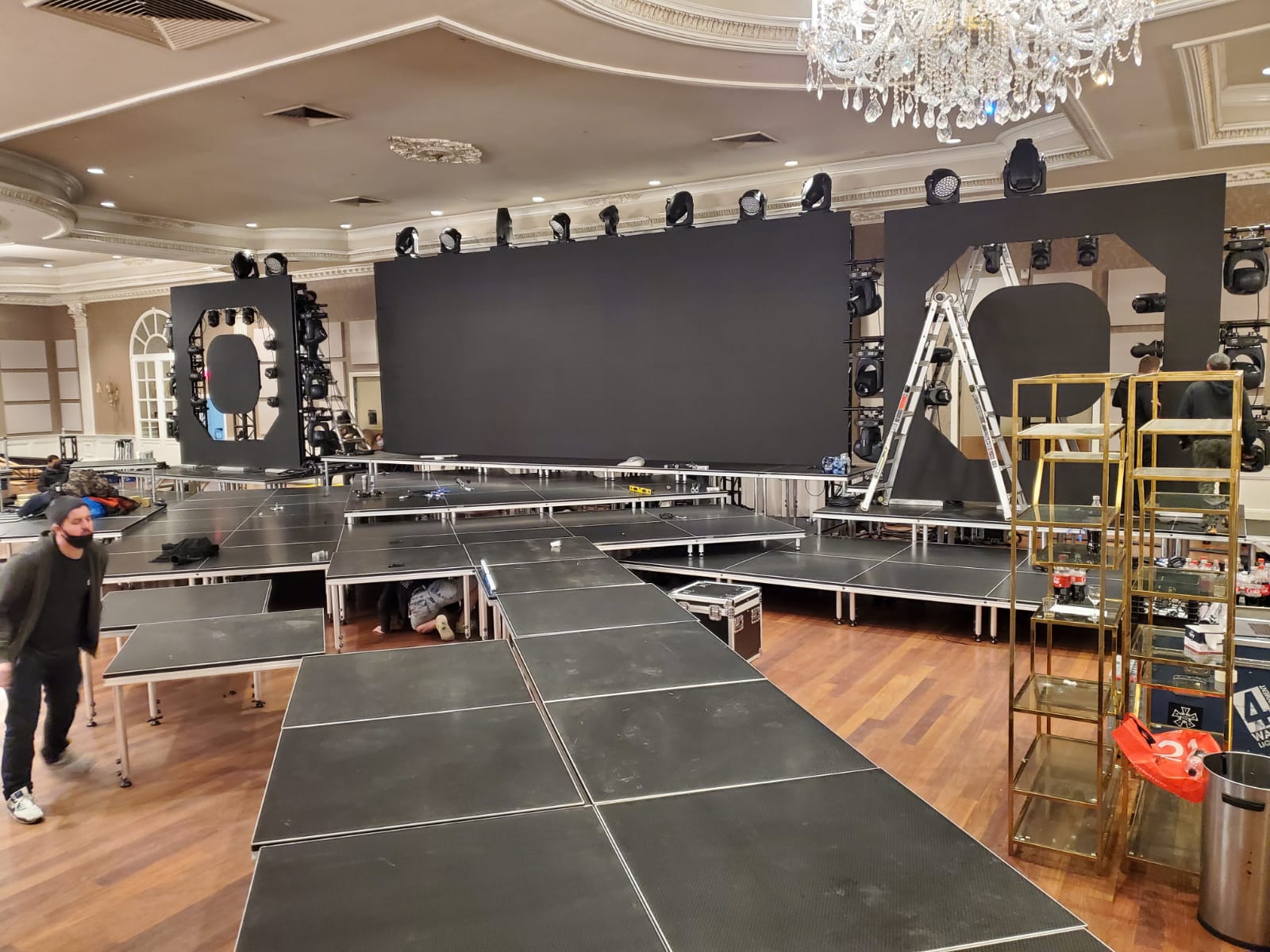
Broadway has an answer for everything the live events industry keeps learning the hard way: the scene change is not a pause in the show — it IS part of the show. Corporate and live event production has borrowed liberally from theatrical tradition when it comes to set design and staging, but has often neglected the theatrical discipline of treating transitions as choreographed moments with their own timing, crew assignments, and creative intent. The result is an industry full of events where brilliant segments are separated by awkward minutes of visible crew scrambling under uncomfortable work lights while the audience waits and the momentum dies.
The Broadway Model: What Theatrical Production Teaches Corporate Events
Broadway scene changes have been timed to fractions of a second since the introduction of flying systems and turntable stages in the 19th century. The Hamilton production uses a two-turntable stage configuration specifically engineered to enable near-instantaneous scene transitions without lowering a curtain. Scenic elements are pre-positioned, rigged, and ready to move the moment the previous scene’s final cue is executed.
The live events industry’s equivalent is the production table reset — replacing a CEO keynote stage layout with a panel discussion setup between segments. Without a dedicated plan, this becomes a scramble. With a plan that borrows theatrical discipline, it becomes a production beat. The difference is entirely in the pre-production work.
The Change Schedule: Building the Map Before the Show Day
The foundation of a fast scene change strategy is a written change schedule — a document that lists every transition in the event, the elements that need to move or reset, the crew members responsible for each element, the cue that triggers the change, and the target completion time. This document is distinct from the run-of-show and more granular than the stage manager’s cue sheet. It is specific to crew members executing physical changes during the event.
Software tools like Showtime, Productiontalk, and even well-structured Google Sheets templates are used by production teams to build and distribute change schedules. The critical requirement is that every crew member involved in a scene change has a personal copy of the schedule — preferably on a tablet or phone that can be referenced during the dark — and knows exactly what they are responsible for before the day begins.
Zone Assignment: The Crew Grid That Makes Transitions Predictable
Large format events with complex staging — award shows, corporate galas, product launches with multiple stage configurations — benefit from a zone assignment model in which the stage is divided into zones and specific crew members are assigned responsibility for their zone across all transitions in the event. The zone owner knows their area, controls their elements, and doesn’t have to interpret new instructions mid-show.
This model was formalized in touring theatrical production and has been widely adopted in corporate event production as staging complexity has increased. A zone captain — typically a senior stagehand or stage supervisor — coordinates the zone’s activity and communicates with the stage manager on the timeline of their completion. The stage manager holds the show until all zone captains have confirmed their transition is complete. That confirmation loop is what prevents a scene change from being called done when one element is still being positioned.
The Pre-Set Protocol: What Happens Before Anyone Knows It’s Happening
The fastest scene changes are the ones the audience never sees building. Pre-setting — positioning elements for upcoming scenes during earlier segments while the stage is not the primary focus — is standard theatrical practice that live event production teams have adopted with significant results.
A pre-set crew working during audience registration, pre-function entertainment, or a video playback moment can position risers, adjust furniture, pre-coil cables, and stage small props in their final positions for the next scene configuration. When the transition comes, the change becomes a simple reveal rather than a construction project. The stage manager needs to build pre-set moments into the run-of-show and protect the time required — pre-setting that gets interrupted by unexpected schedule changes loses its value immediately.
Lighting as a Scene Change Tool: More Than Just Blackouts
The lighting designer’s role in a scene change strategy is often under-utilized in live event production. A blackout is the blunt instrument of scene change lighting — it buys time by removing audience visibility, but it also creates anxiety, breaks emotional continuity, and signals that something technical is happening rather than something intentional.
More sophisticated productions use transitional lighting states — programmed cues on the grandMA3 or ETC Eos that carry audiences through the change with atmospheric lighting, audience illumination at a designed level, or moving light patterns that create visual interest without revealing the crew work. A well-designed transition cue can give a stage change crew 60 to 90 seconds of covered time while the audience experiences something intentional rather than waiting for something to happen.
Audio in Scene Changes: The Sound That Bridges Moments
Music playback during scene changes is one of the most powerful tools in the event producer’s toolkit and one of the most commonly treated as an afterthought. A transition music track selected for tempo, energy, and tonal relationship to the content on either side of the change carries the audience’s emotional state through the transition and sets the tone for what follows.
Productions using QLab for audio playback can program precise track selections with fade timing, volume automation, and output routing that integrates directly into the show file and triggers on the stage manager’s cue call. The audio operator doesn’t have to make a judgment call mid-show about what to play — the decision was made in pre-production and is executed automatically.
The Rehearsal That Cannot Be Skipped
Scene change strategy is not executable from a document. It requires a physical rehearsal — crew in position, on headsets, running through each transition in sequence, at show speed. The first time a crew runs a scene change should never be during the actual event. The elements that look simple on paper reveal their complexity when human beings are executing them in the dark under time pressure.
A dedicated crew rehearsal — sometimes called a work call in the event production world — specifically to rehearse transitions, run by the stage manager with stopwatch accountability, is the investment that makes the actual show feel effortless. Productions that skip this step routinely discover on show day that their 90-second transition plan requires three minutes in practice. Three minutes during a live event is an eternity that the audience will never let you forget.
