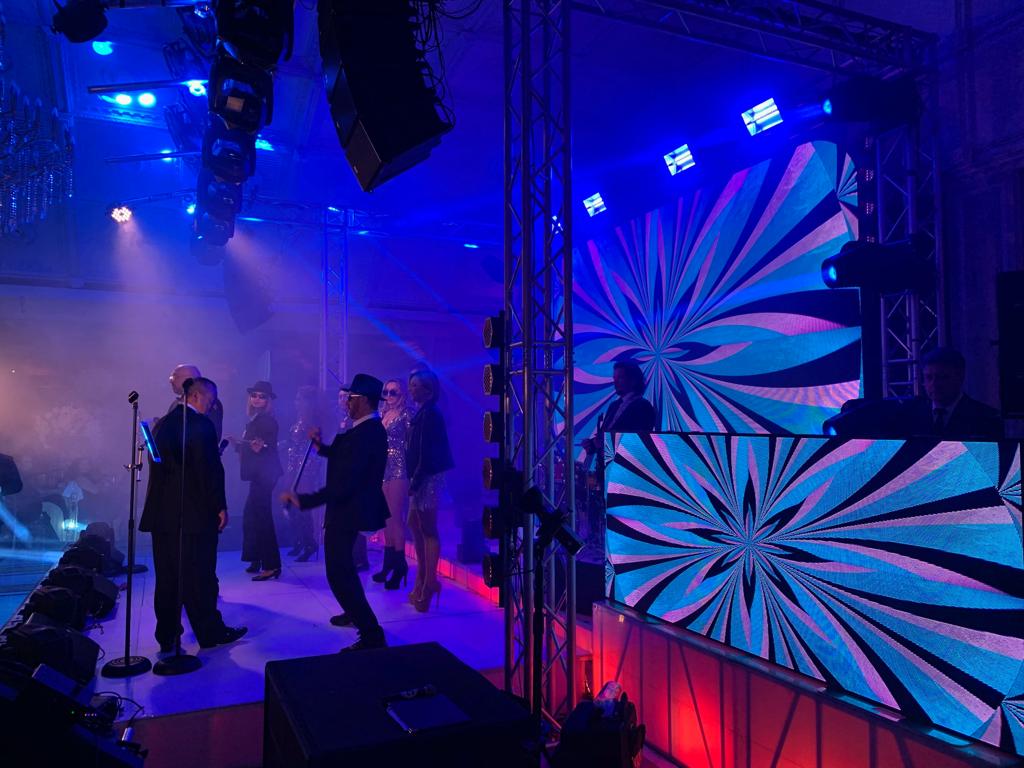
The Marriott Marquis ballroom in New York City has a ceiling height of 22 feet and enough square footage to feel expansive until a full AV production moves in. Then the room reveals its geometry: columns at precise intervals that destroy sightlines, HVAC diffusers positioned directly above every stage position the LD would choose, and a house rigging grid that was designed for drape and chandelier loads, not the dynamic load requirements of a six-point motor lift for a 40-foot I-mag screen. Hotel ballrooms are the most common venue in the corporate events industry and among the most technically challenging. The constraints are invisible until the equipment arrives.
The Historical Context: Hotel Ballrooms Were Not Built for AV Production
Hotel ballroom design has been driven by hospitality considerations since the grand hotel era of the late 19th century. The Waldorf-Astoria’s grand ballroom, opened in 1931, set the architectural standard for American hotel ballroom design: high ceilings, elaborate chandeliers, polished floors, and acoustics optimized for the sound of a live orchestra and dinner conversation rather than amplified speech or concert-level PA systems.
The introduction of corporate meeting and event business as a primary hotel revenue segment in the 1970s and 1980s transformed how hotels valued their ballroom inventory — but the physical infrastructure of most hotel ballrooms was not upgraded to match the production ambitions of corporate clients. The result is a persistent mismatch between what event producers want to do in hotel ballrooms and what the buildings were designed to support.
Ceiling Height and the Physics of Image Size
The relationship between ceiling height and image size is one of the fundamental constraints in hotel ballroom AV design. A ballroom with a 14-foot ceiling — common in properties built in the 1960s and 1970s — can support a front-projection screen of limited height before the projector throw conflicts with the ceiling structure. The standard 16×9 aspect ratio screen large enough to be visible from the back of a 300-person room requires a ceiling height of at least 14 feet just to accommodate the screen, with additional clearance needed for projection throw geometry and drape masking.
The industry response has been a shift toward LED video walls in applications where ceiling height constrains front-projection geometry. An LED panel system from Absen or ROE Visual can be configured at lower heights than a projection screen and front-loaded projection rig, and provides significantly higher brightness in rooms where ambient light control is limited. The tradeoff is cost — an LED wall sized for a 300-person ballroom represents a significantly higher rental cost than a projection system — and the physical weight and rigging load of the panel structure.
Column Sightlines and the Art of the Compromise
Hotel ballroom columns are sightline destroyers. They exist because the building structure requires them, and no amount of creative AV design fully compensates for an audience member sitting directly behind a column. The professional approach is to identify column positions during the venue site survey and design the room layout to minimize the number of seats with impaired sightlines.
Tools like AutoCAD and Vectorworks are used to draft sightline diagrams that model the audience perspective from every table position, factoring in column locations, screen height, and audience seating density. This modeling, done during pre-production, allows the production team to propose room layout adjustments to the venue that improve sightlines before the event day reveals the problem. A post-load-in sightline discovery is expensive — rearranging tables and chairs after the AV is set costs time and crew.
HVAC and Acoustics: The Hidden Enemy of Hotel Ballroom Audio
Hotel HVAC systems are the front-of-house engineer’s adversary. The noise floor of a hotel ballroom with HVAC running is typically in the 45-to-55 dB range — significantly above the 35 dB ambient level that audio engineers consider acceptable for speech-primary events. The HVAC noise is broadband, meaning it competes with vocal intelligibility across the entire frequency range rather than being filterable through equalization.
The standard professional response is to request that venue engineering reduce HVAC fan speed during the event. Most hotel ballroom HVAC systems can be run at reduced capacity for periods of several hours without significant impact on room temperature — particularly when the room is fully occupied and body heat compensates for reduced system output. The request should be made in advance of the load-in, coordinated with the venue’s chief engineer, and confirmed on show day. A verbal commitment from a sales manager does not constitute a confirmed HVAC configuration.
Acoustic treatments — hanging baffles, temporary drape systems, fabric panels — can reduce the reverberation time of a hard-surfaced hotel ballroom from 2.5-plus seconds to a more manageable 1.2 to 1.5 seconds. Systems like the d&b audiotechnik ArrayProcessing can partially compensate for difficult room acoustics through beam steering and directional output, but physical acoustic treatment remains the most effective intervention for rooms with significant reverb problems.
Rigging: What the Ceiling Can and Cannot Support
Hotel ballroom rigging capacity is a legal, structural, and logistical variable that must be investigated before any equipment is specified for a hang. Most hotel ballrooms have rigging points rated for chandelier loads — typically 50 to 200 pounds per point — not for production rigging loads that may require 1,000 pounds per point or more for screen structures, truss, or speaker arrays.
The production manager’s responsibility is to obtain the structural loading specifications for every rigging point in the ballroom from the venue’s engineering department, and to have a structural engineer review the proposed hang plan if loads approach or exceed the rated capacity. In venues with inadequate rigging capacity, the production design must shift to floor-supported structures — ground-support truss systems from manufacturers like Global Truss or Prolyte — which introduce their own footprint and sightline considerations.
Power: Never Assume It Exists
Hotel ballroom power distribution is one of the most commonly misrepresented aspects of venue technical specifications. A sales document may list ‘200 amps of power available in the ballroom’ without specifying how many circuits carry that 200 amps, where the panels are located, what the feeder distance is from the panel to the stage, or what else in the building shares those circuits.
Professional production requires a power audit — conducted with the venue’s chief engineer — that identifies available amperage, circuit locations, phase configuration, and any other load on the circuits that will be serving the production. A hotel ballroom sharing its power panel with the kitchen on a circuit breaker that the chef controls is not a hypothetical scenario. Arriving to that realization during load-in, with the client present, is a position no production manager wants to occupy.
