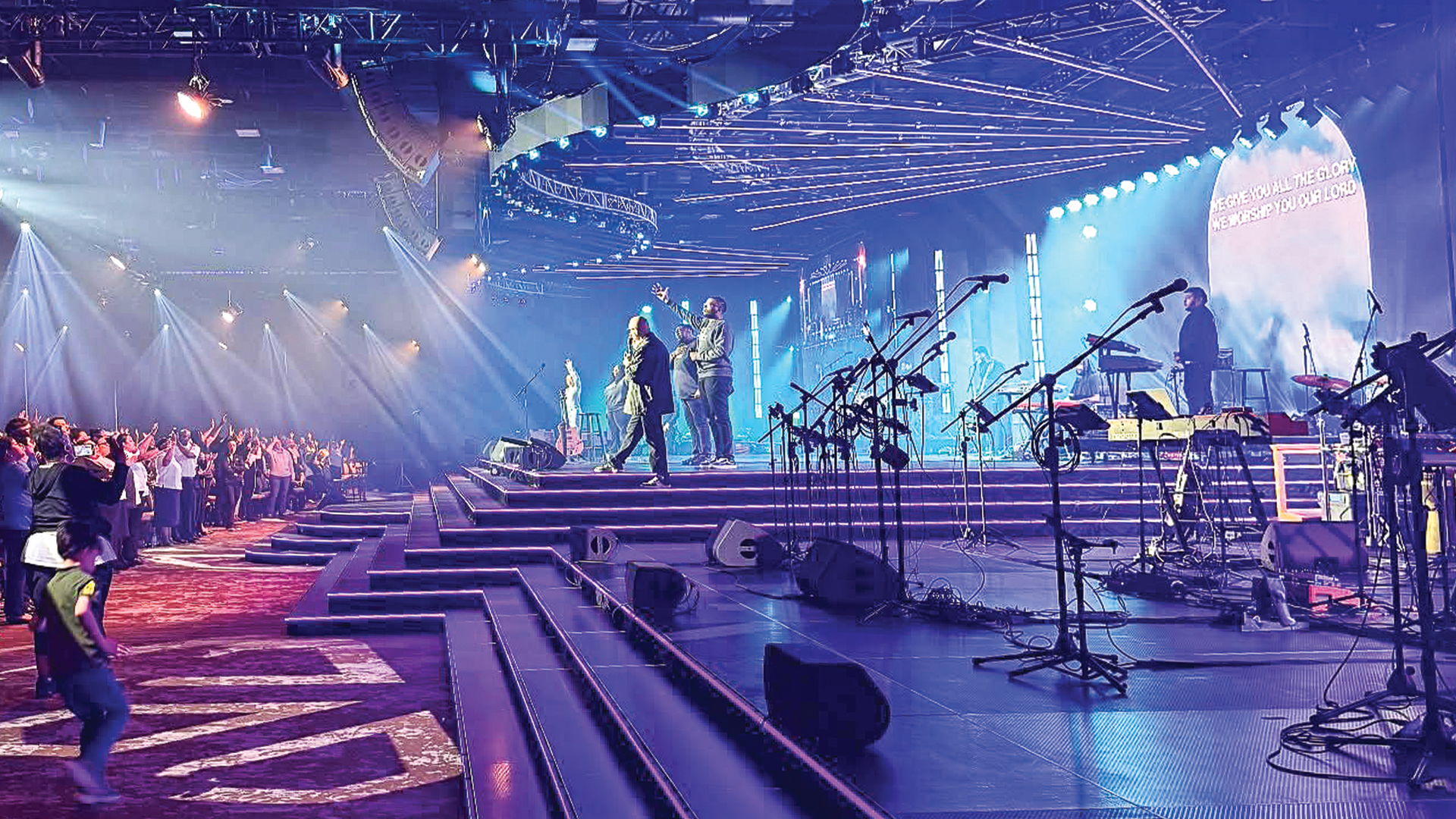
The difference between a corporate event that feels polished and one that reads as ordinary often comes down to sophisticated color choices in lighting design. While saturated primary colors might energize a product launch, they can undermine the gravitas expected at a shareholder meeting or executive summit. Understanding color theory principles elevates production work from functional illumination to atmospheric storytelling.
The Foundation: Color Temperature and Corporate Settings
Corporate environments traditionally favor neutral to warm white lighting, typically ranging from 3200K to 4500K. This range flatters skin tones on camera while projecting professionalism. Fixtures like the ETC Source Four LED Series 3 and ARRI SkyPanel provide exceptional control over color temperature, allowing designers to dial in precise values that complement both the event aesthetic and camera requirements.
The Color Rendering Index (CRI) becomes crucial in high-end corporate work. Fixtures rating above CRI 95 reproduce colors faithfully, ensuring brand elements appear accurate and executive complexions look natural. The Chauvet Ovation E-910FC and Elation KL Fresnel 8 FC both achieve this benchmark while offering the versatility demanded by corporate production.
Working with Brand Colors
Most corporations maintain strict brand guidelines specifying exact Pantone or CMYK values for their colors. Translating these specifications into LED lighting requires understanding the HSL (Hue, Saturation, Lightness) color model and recognizing that additive light color mixing differs fundamentally from printed color.
Lighting consoles like the grandMA3 and Hog 4 include color picker tools allowing designers to input specific values, but visual calibration remains essential. X-Rite colorimeters used alongside LED fixtures provide objective measurements ensuring the lighting matches approved brand standards.
- Request vector brand files containing exact color specifications from the client’s marketing team
- Build color libraries in the lighting console for frequently-used corporate clients
- Account for surface interaction—the same light appears differently on fabric, painted surfaces, and LED screens
- Document successful color recipes for consistency across multiple events with the same client
The Psychology of Subtle Color
Corporate audiences respond subconsciously to color choices. Deep blues suggest stability and trustworthiness—explaining their prevalence in financial services presentations. Warm ambers create feelings of invitation and approachability. Cool whites signal precision and technological sophistication.
The Gestalt principles of visual perception apply directly to lighting design. Creating clear distinction between stage and audience areas through color contrast helps focus attention without requiring dramatic color choices. A slight warming of stage lighting against cooler ambient house light achieves this separation elegantly.
Historical Context: The Edison Era to LED Revolution
For decades, corporate events relied on tungsten sources with inherent warm color temperatures around 3200K. The transition to fluorescent and early LED sources in the 1990s and 2000s introduced color accuracy challenges that frustrated designers accustomed to the reliable warmth of incandescent light.
Modern LED technology from manufacturers like ETC, ARRI, and Rosco has largely resolved these issues. The seven-color LED array approach pioneered by ETC adds phosphor-converted amber, lime, and cyan to traditional RGB-W configurations, dramatically improving CRI scores and enabling nuanced color reproduction that rivals tungsten sources.
Monochromatic and Analogous Schemes
High-end corporate looks frequently employ monochromatic color schemes—variations of a single hue at different saturations and brightness levels. This approach creates visual sophistication without the complexity of managing multiple complementary colors.
An executive summit might use shades of blue ranging from pale arctic blue at 10% saturation for general wash to rich sapphire at 70% saturation for accent lighting. The consistency reads as intentional and refined rather than random.
Analogous schemes expand this concept by incorporating colors adjacent on the color wheel. A palette moving from teal through blue to violet provides variety while maintaining harmony. The Martin MAC Ultra Performance and similar fixtures with extended color mixing capabilities excel at these subtle shifts.
The Role of Gobos and Texture
Pattern projection adds dimensionality to corporate lighting without introducing additional colors. Glass gobos from Apollo Design and GAM Products create sophisticated breakup effects that add visual interest to otherwise flat surfaces. Abstract patterns reading as architectural details or natural light suggest high production values while maintaining professional restraint.
Custom corporate logo gobos have become standard for branded environments. The Rosco Custom Gobos service and similar offerings allow precise reproduction of corporate identity elements in light—a technique dating to theater practice but refined for corporate applications in the 1980s.
Camera Considerations
Corporate events increasingly incorporate IMAG (image magnification) and live streaming components. Lighting color choices must satisfy both live audiences and camera sensors. The phenomenon of metamerism—where two colors appear identical to human eyes but different to cameras—requires testing before the event.
Production companies like PSAV and Encore maintain reference charts documenting how specific LED fixture and camera combinations render various colors. These resources prove invaluable when designing lighting that must perform for multiple capture systems simultaneously.
Practical Application: The Executive Presentation
Consider a typical high-stakes corporate scenario: a CEO addressing investors and analysts. The lighting design goals include:
- Flattering key light on the presenter at 3800K with CRI above 95
- Sufficient fill to reduce shadows without eliminating dimension
- Background lighting incorporating brand accent color at 15-25% saturation
- Edge lighting separating the presenter from background elements
- House lighting at 20% intensity in slightly cooler temperature to create focus
This formula, executed with quality fixtures and precise color control, produces the polished results expected at premier corporate gatherings. The restraint in color choice paradoxically creates greater impact than saturated alternatives—a principle lighting designers learn through experience and study of classical color theory dating to the work of Johannes Itten and Josef Albers.
