When Delay Systems Demand the Spotlight
The Attention-Seeking Speaker Stack
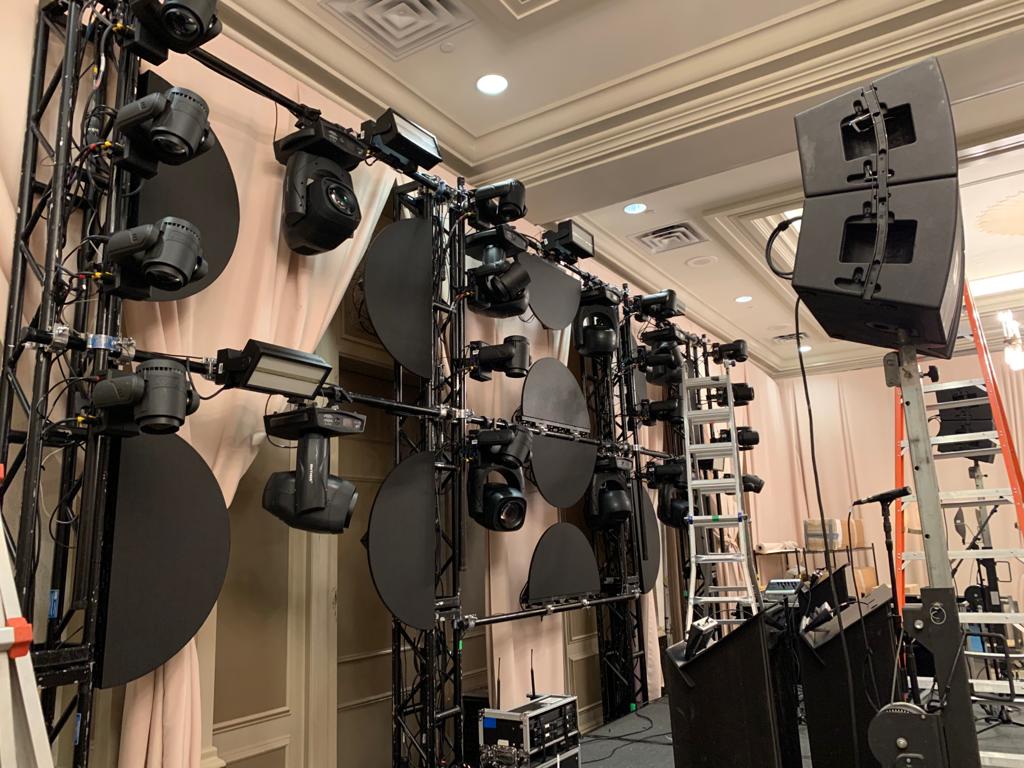
The delay tower positioned two hundred feet from the main stage had one job: provide time-aligned audio reinforcement for the rear portion of the festival field. Instead, it had apparently decided to audition for lead performer status, producing output levels approximately 15 dB hotter than system design specified. The audience near the tower couldn’t hear the actual band over the overwhelming local reinforcement. Complaints flooded the production office while the system engineer sprinted across the field trying to determine why their carefully calibrated delay system had developed ambitions beyond its station.
Understanding Delay Tower Purpose and Design
The distributed loudspeaker system concept addresses the physical reality that sound loses energy over distance. The inverse square law dictates that sound pressure drops 6 dB with every doubling of distance from the source. A listener 200 feet from the main PA hang receives approximately 18 dB less direct sound than someone at 50 feet. Delay towers restore level at distance while maintaining the time relationship that preserves sonic coherence with the main system.
Proper delay alignment requires precise measurement of propagation time from main system to delay position, then delaying the tower’s output to arrive simultaneously with direct sound from the stage. The SMAART and SysTune measurement platforms provide transfer function analysis that enables accurate alignment. The Lake LM44 and Galileo Galaxy processors that control modern delay systems offer millisecond-resolution adjustment for achieving seamless integration.
Common Causes of Delay Tower Rebellion
The most frequent cause of over-loud delay towers involves processor misconfiguration—output gain settings that don’t match system design, or parametric EQ changes that increase overall level while addressing specific frequency issues. The d&b ArrayCalc predictions that determine appropriate tower levels assume specific processor settings. Deviation from those settings—whether intentional adjustment or accidental modification—breaks the calibration that makes distributed systems work.
Temperature and humidity changes between soundcheck and showtime alter acoustic propagation in ways that affect delay system balance. Sound travels faster through warm air, potentially creating timing mismatches between main and delay systems tuned in different conditions. The Outline Newton processor’s automatic climate compensation attempts to address these variables, though the effectiveness depends on accurate environmental sensing.
Network and Control System Failures
Delay towers connected through audio networks experience failure modes impossible in hardwired systems. Dante and AVB latency variations, though typically minimal, can create timing inconsistencies that affect delay alignment. More dramatically, network switch failures can cause towers to lose connection with controlling processors, potentially defaulting to states with incorrect settings.
The remote control capability that enables system engineers to adjust delay towers from mix position also enables accidental or unauthorized changes. A tower accessible through Galileo Galaxy software can be modified by anyone with network access and software credentials—or by software glitches that apply random changes. The production that implements configuration locks and password protection prevents the unauthorized modifications that create seemingly inexplicable behavior.
Environmental Factors
Wind affects delay tower performance dramatically. The directional characteristics of line arrays assume relatively still air; wind bends coverage patterns away from intended target areas while potentially directing output toward unintended zones. A tower carefully aimed at the rear field may effectively refocus toward the mix position during steady crosswinds, creating the apparent imbalance where tower output overwhelms program audio.
The ground reflection patterns from delay tower positions differ from main system configurations. Towers positioned on platforms above audience head height interact with ground surfaces differently than towers at grade level. These reflections can reinforce certain frequencies to produce localized hot spots that exceed intended levels even when amplifier gains remain correct.
Troubleshooting Methodology
Diagnosing demanding delay towers requires systematic isolation of variables. The first step involves physical verification at the tower itself—confirming that amplifier levels, processor settings, and speaker connections match specification. Remote monitoring through d&b R1 or Galileo Control can be deceiving if network communication issues create inaccurate status reports.
Comparative measurement between misbehaving and properly functioning towers identifies deviation sources. Running pink noise through the system while measuring response at multiple positions reveals whether problems originate in processing, amplification, or acoustic factors. The transfer function comparison between towers should show similar response curves if both are correctly configured.
System Design for Reliability
Preventing delay tower rebellion begins during system design rather than showtime troubleshooting. Building adequate safety margins into tower levels means that component variations or environmental changes don’t push systems into audibly problematic territory. The designer who specifies towers at 90% of maximum useful output leaves room for real-world variation.
Implementing monitoring and alarming on delay systems enables rapid detection of developing problems. The Shure AXT600 spectrum manager and similar tools can monitor RF environments that affect wireless systems at towers. Amplifier monitoring through d&b ArrayProcessing or equivalent provides real-time confirmation that towers perform as designed—or early warning when they begin pursuing their own agenda.
